Friday, July 22, 2016

Lowder Mountain

So Richard, where did you go hiking?

I said "Lowder! And why are you yelling at me?" Yeah, yeah, I know...weak pun but that's my tortured segue into a discussion about hiking on Lowder Mountain and I'm sticking to it.

Prince's pine
The night before, I had enjoyed some good music at Sam Bond's Garage, which is rapidly becoming a second home away from home now that I'm retired. So while the concert was pretty cool (even though it was Lowd), it made for a very late night by the time I drove back to Roseburg. And since late nights are not conducive to early morning risings, especially in my retirement years, it stood to reason that any hiking done the day after would have to be late in starting, and moderate in length and ambition. Ergo, I began my hike on Lowder Mountain at the shameful hour of 2:00PM, and why are you yelling at me?

Beautifully shaded trail
After just 5 yards of hiking, it was apparent that the main attraction (for the time being) would be the lush forest. Green vegetation and dark shade was the theme and the forest floor was carpeted with green leaves and delicate accents of foamflower sprays. Fragrant heart-shaped leaves of wild ginger hid the ugly brown flowers underneath, but I knew how to find them. Large clumps of pink woodland phlox and prince's pine were abloom on the forest floor and a profound hush permeated through the trees. Yes, I said hush, there was nary a mosquito whine to be heard and I almost missed the little buggers.

Vine maple provides green-colored ambiance
The trail climbed up through the forest in a series of switchbacks but the grade was fairly gentle. The map said I was walking above Quaking Aspen Swamp which I looked forward to exploring. However, the thick forest prevented access and vision thereof, no swamp or quaking aspen for me. But a dense canopy of vine-maple leaves colored the air green and kept the temperature mild; life was good on the trail despite the lack of quaking, aspens, or swamps. Periodically, the trail would enter open meadows clinging to the slopes of Lowder Mountain, where columbine, tiger lily, and coneflower bloomed the day away under a cobalt blue sky. 

Meadow on Lowder Mountain's slopes


As the trail gained elevation, the trend was toward less forest and more meadows. And with the meadows came views of the deep valleys of the South Fork McKenzie River, one of which contained Cougar Reservoir hiding below. One of the mountains on the other side of Cougar Reservoir is called Deathball Mountain and I would love to know the story behind that name! With a moniker like that, I should climb it and just make up the story of how it got its name. It would save me some tedious factual research!

Zen moment


In a grassy meadow, a worn down trail sign marked the intersection with the trail leading to Yankee Mountain and then down to Cougar Reservoir in a knee-taxing descent. I looked on the map and the trail either loses or gains elevation, depending which way you are hiking it. Either way, the elevation change is 3,300 feet in 1.9 miles: whew! With stats like that, that particular trail just got on my list for future hikes!


Just follow the cairns


Anyway, after the intersection, the Lowder Mountain Trail started to climb in earnest, leaving the meadows behind and entering anew a dark and shady forest. Again, switchbacks kept the grade manageable for the most part. Suddenly, the trail spit me out onto an unexpected pumice barren and my eyes squinted myopically in the bright sunlight. The trail became somewhat faint but there were a series of rock cairns to keep me on track.

The Three Sisters


Horsepasture Mountain across the East Fork
South Fork McKenzie River canyon

Karl and Ruth Lakes
Lowder Mountain doesn't seem like much of a mountain when you are hiking on it as the summit is as large and flat as an Arizona mesa. The trail really became hard to follow in the vegetation as it went around a rather large and sparse meadow ringed by trees. The meadow (and Lowder Mountain, too) abruptly ended at a very tall cliff and the view from that rocky perch is why we hike. The snowcapped peaks of Middle Sister and North Sister hugged each other in permanent sisterhood while South Sister stood by her aloof self . Beyond green and forested Horsepasture Mountain rose Mount Jefferson and a cloud bank on the distant Columbia River hid Mount Hood from view. In between were lesser peaks such as Three-Fingered Jack, Mount Washington, Belknap Crater and Broken Top. To the south, the tip of Diamond Peak was visible. And directly below, Karl and Ruth Lakes lay in a forested basin. A view for the ages, once again!

Thimbleberry was everywhere
As I left, another hiker emerged from a nearby viewpoint and I greeted him with a "I thought I had the mountain to myself!" He smiled and replied "Well, I was here first". He was Brian, from Eugene, and we happily talked trails on the way back from the mountain, making the miles go by quickly. When we reached the trailhead I asked him "What was the name of this mountain, again?"

Golden yarrow


"Lowder", he helpfully replied.

"What was the name of this mountain, again?"

He seemed to be such a nice guy too, but he did leave in a hurry for some reason. He didn't even say good-bye but that's OK, his actions spoke Lowder than words. 

Cow parsnip catches some afternoon light
For more pictures of this hike, please visit the Flickr album.

Saturday, July 16, 2016

Mount Ashland Meadows

One of our hiking buddies once commented that given the right mood and ambition, he might go on a Richard Hike. And under the same conditions he might go on a Ray Hike. But he would never, ever go on a Richard and Ray Hike! We took it as a compliment. Sadly, my Trail Brother Ray recently passed away and all I've been thinking about is the wonderful adventures we shared in such a short time. We've hiked not only in beautiful weather but have hiked, camped, and backpacked in rain, sleet, snow, ice, thunder, lightning, and gale-force winds. We hiked not only in our Umpqua National Forest but we also trekked in Washington and California, visiting many a remote wilderness area in the process. We slapped at mosquitoes and blackflies, danced away from rattlesnakes, and fought off marauding deer. We walked on beach sand, rocky trails, snow drifts, volcanic ash, and waded across many a creek or river. Sometimes we hiked where there were no trails at all.  And all the while, a steady dialogue of good natured insults were directed at each other. And of course, there was "The Ray", his signature pose where he raised his arms and hiking poles overhead, usually in triumph and glory atop a mountain summit. It seemed like every hike was epic and most certainly were memorable. 

Mount Ashland
When we did not hike with each other, we hiked where the other had not yet been. Upon returning home, the taunting began with "Guess where I went today?" emails going back and forth. It was a ritual of sorts where the tauntee would complain to the tauntor about tainting the trail for future use. Ray and I had talked about doing a weekend backpack trip on the Pacific Crest Trail from Mount Ashland Meadows to Wrangle Gap but for whatever reason, we never pulled it off. We also talked about hiking to Siskiyou Peak as a 12'ish mile out-and-back day hike. And one particular day I did do that very thing and got to taint the trail for Ray. Later on, he did the same hike and shared his pictures with me and even though I had already been, it still felt like a taunt and taint.

Trail marker on the Pacific Crest Trail
So, when the Friends of the Umpqua went hiking on the slopes of Mount Ashland, I went along not only for the magnificent hike, but also to reminisce and to mourn the loss of a good friend. The Pacific Crest Trail doesn't care about all that though, it just lays on the ground and lets people walk on it from Mexico to Canada or vise versa. The PCT thru-hikers usually hit Oregon late July and we encountered many thru-hikers who were easily distinguished by long beards, unshaven armpits, dirty clothing, and a certain air about them that lingered in the forest long after they passed by. And the men were just as bad!

Monkshood


From the paved Mount Ashland Road, the PCT headed through a beautifully shaded forest comprised of tall conifers of various ilk. At the outset, the route took us through several small meadows in a foretaste of the magnificent meadowy goodness yet to come. The meadows were buzzing with bees harvesting pollen from the flowers. The trail was fairly level with gently rolling ups and downs and I sure love a trail with no mosquitoes on it.


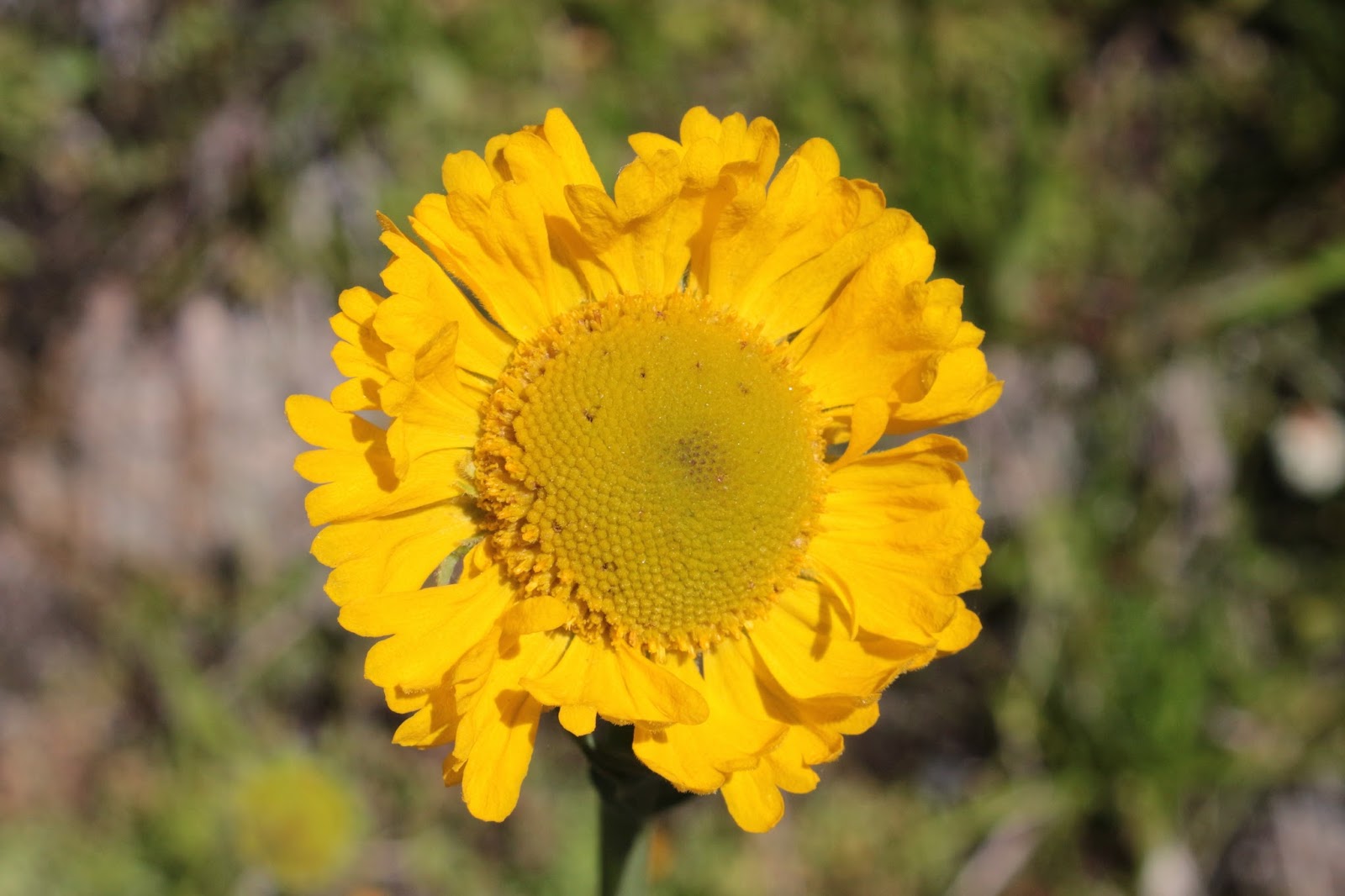
Sneezeweed
After a mile or so, the trail crossed a dirt road and contoured across a rather large meadow clinging to Mount Ashland itself. Hellebore (also known as corn lily) was putting on a show along with sneezeweed, orange agoseris, tiger lily, and mountain owl's clover. Mount Ashland's profile (with a white microwave dome thingy on it) was photogenically etched against a dark blue sky.


Grouse Gap, one of my favorite places
The trail did enter the dark forest again but the trend was towards more meadow and less forest to the point where it would be all meadow and no forest. Grouse Gap is the grassy bowl where the transition to meadow becomes complete. Numerous springs and creeklets ran across the trail and the vista of green  slopes and distant mountains and valleys was pretty awesome. The Siskiyou Mountains figuratively dropped away at our feet, providing nice views of the Shasta Valley with Mount Shasta lording its snow-capped peak over us lesser beings. 

Mount Ashland lupine
John, Edwin, and I said good-bye to the hiking club at Grouse Gap and performed a short bushwhack on a pumice barren back up to the PCT. The Mount Ashland lupine, a miniature lupine endemic to the area and found nowhere else, covered the slope in half-inch high mats of grayish leaves and purple flowers. We made sure not to step on the rare and endangered lupine as we hiked up but the grasshoppers apparently find the plant quite tasty and don't care about the rarity thereof.

The PCT climbs to the Siskiyous crest


From Grouse Gap, the trail charged up a rocky cliff that had snow patches under the trees. However, the slope was relatively short so the uphill agony was short-lived, plus it offered a nice view of Mount McLaughlin's tip. And always, Mount Ashland was eminently visible across Grouse Gap. The three of us thought we were hikers extraordinaire until a young lady passed us by, out for a casual 20+ mile trail run. After bidding her adieu, we old and decrepit hikers adjusted our canes and walkers and bravely continued on, at our aged snail's pace.


John and Edwin explore Peak 7079
We called it good at Peak 7079, which was just short of Siskiyou Peak but still a respectable 10+ mile hike. We scrambled up to the top which sounds impressive until you consider the summit was only about 10 feet higher than the trail. But hey, that's how old mountain climbers roll! The terrain here was sparse and treeless so from the relatively small peak, we enjoyed the ho-hum, rather usual stunning vista to Mount Shasta and the rest of California. The view to the south was new and it was Oregon too, so naturally it was more beautiful. 

The Siskiyous are calling me and I must go


Wagner Butte lay immediately to the south and we could trace our route on nearby Mount Ashland. Several other peaks on the crest of the Siskiyous loomed to the southwest, notably Siskiyou Peak, Big Red Mountain, and Observation Peak. And don't you know I want to backpack the Siskiyou Mountains crest one of these days. Music floated up from a nearby spring in form of tinkling cowbells on a herd of cattle grazing in the hellebore. 

The Ray
On the way back, the shadows lengthened in the forest and the meadows were bathed in the afternoon glow. I'd like to say that I put Ray to rest but that'll be a process that will take a lot longer than a mere 10 miles of trail. Let's just say he was sort of with me this day and wherever he is, he'll swear I tainted this particular section of the Pacific Crest Trail. Miss you, Trail Brother.

Cow parsnip
For more pictures of this hike, please visit the Flickr album.

Monday, July 4, 2016

Sutton Creek

"I'll go with you, but take it easy on me!" says Dollie. What is this? My brother David said the same thing several hikes ago. It's like this vast conspiracy to keep hikes short. And probably downhill too! Well, let it be known I've had enough and will no longer yield to the forces of trail oppression, it is time to stand up and shout to the heavens "We will hike 10 miles uphill and you will LIKE it!"  Yeah, you are all correct, I just bowed my head and meekly said "Yes, dear".

Coastal forest above the trail
Sutton Creek was chosen because it is easy (unless the trail is underwater like the last three times I've been there), on an easy to follow trail (unless you go cross-country and bushwhack like the last two times I've been there), and fairly short (unless you go through Baker Beach Dunes and loop back from the mouth of Sutton Creek, like the last time I was there). Sigh.


Heh, heh, heh
We started at Dune Lake, just off of Highway 101, and immediately headed uphill on a sandy track from the day use area at the lake. The trail was comprised of soft sand that taxed calf muscles and I silently laughed "heh heh heh" at Dollie as we hiked. A faint path took us on a steep climb on soft sand (tee hee, again) up to the Alder Dunes area.


Alder Dunes and me without a trail
Here the trees thinned out and the dunes were pretty much covered in beachgrass. From past experience, there is a faint path that would keep us on the north side of Sutton Creek which would then allow us to get to the beach without having to wade across Sutton Creek. However, I was unable to locate the path so I just faked it and acted like I knew exactly where we were going.


Typical scenery on this hike
So, straight across the dunes we go to the other side where we picked up the Alder Dunes Trail which took us into a thick forest with actual packed dirt for trail tread, darn it. The forest was wonderfully shaded and the mottled light kept a certain camera-toting hiker happy, despite the tame hiking conditions. 

Rhododendron, catching a few rays
Rhododendrons were no longer blooming, but their leaves caught the light nicely for the camera. Besides the tall rhodies, the forest sported a thick and impenetrable undergrowth of salal and coastal huckleberry. The vegetation hulked over the trail and it seemed like we hiked through an endless series of dark tunnels. I'm glad to report that despite the ominous appearance of the tunnels, no deer lay in wait for us innocents. 

Bridge over Sutton Creek
After several miles, the path crossed Sutton Creek on a stout footbridge. The creek flowed languidly in keeping with our hiking pace and the water was stained brown-red by tannin accumulation, or so I presume. For the remainder of the hike, the creek would flow within sight below the trail.


Sutton Creek, near the beach


We rejoined civilization when the trail spit us out into the paved Holman Vista parking lot. From there, a very short walk on a boardwalk provided a look down at the creek. It was much cooler to actually walk in soft sand down to the creek's edge. The forest ended here and a broad marshy plain lay behind the beach foredunes with Sea Lion Point rising above it all to the north. We deliberated about wading across the creek and walking to the beach but a chill wind blowing briskly dissuaded us of that notion. Plus, I was obligated to take it easy on a certain participant.

Shady trail
So back the way we went...well, not exactly. We stayed on trail this time, eschewing the cross-country walk across the dunes in an attempt to finish the hike quicker. Tongue tacos at Los Compadres Taqueria in Florence were calling me from across the sands and that's what I call "taking it easy", unless you consider the hot sauce.


"Come into my parlor" said the deer to the hikers
For more pictures of this hike, please visit the Flickr album.

Sunday, July 3, 2016

Coffin Mountain

The second installment of the Short 'n' Sweet Old Cascades Tour 2016 was on Coffin Mountain. Allegedly, if you look at Coffin Mountain from the Detroit Lake area, the peak's outline resembles a coffin. From the Coffin Mountain Lookout Trail, not so much: it more resembles a mountain with a steep trail on it. Sorry, my ability to cobble together a poetic simile escapes me as I trudge uphill through the beargrass under a bright sun. I thought Coffin Mountain might have got its name from a tired hiker who complained, "I'm so dad-gummed tired one more step's gwine to put me into the coffin" Or maybe it was the observation by the same generic tired hiker "This trail's so steep, dangburn it, that it's set me right to coffin'..." And the day I start talking like that will be a day I spent too much time in the sun.  

My view, while eating breakfast
Anyway, the day before, after hiking to the top of Middle Pyramid, I spent the night camped at the Pyramids Trail Trailhead. Bright and early the following morn, I took down my tent and made the short drive over to the Coffin Mountain Trailhead. As I was boiling breakfast on the hood of my car, another auto arrived at the small parking lot. It was new hiking buddy Linda who warned me I would probably pass her on the way up because she takes lots of pictures for her blog (called Linda's Lens, by the way). Boy, could I ever relate and since I too take lots of pictures for my blog, it was doubtful whether I would ever catch up to her. As it turned out, we hiked pretty much at the same slow speed, snapping photos all the while and it was nice to have a very kindred spirit for company on this spectacular hike. 

We're dying, here!
The hike to the Coffin Mountain summit is fairly short, the trail gets there in 1.5 miles while gaining nearly 1,000 feet. Not as rigorous as the Pyramids Trail but tell that to my leg muscles which immediately complained about the brisk climb at the hike's outset. They said something like "Two days in a row? We're dying here..." which is perhaps how Coffin Mountain got its name. Or, perhaps not.


Flowery trail on the climb up


There was very little forest on the east-facing slopes and the trail ambled through some rather lush vegetation. So many flowers to take pictures of, and I was quickly distracted from burning leg muscles by thimbleberry, lupine, columbine, ocean spray, and subalpine Mariposa lily. Since there was very little forest to block the view, I also got to enjoy views of the Three Sisters, Mount Washington, and Three-Fingered Jack.

Beargrass on the hillside


Unfortunately, the view also included a pointy pinnacle that that at the time, I misidentified as the Coffin Mountain summit. Darn false summits do it to me every time. The true summit was still way up there above and beyond the false summit and some anticipatory complaining from quad muscles ensued.  I should learn not to look ahead, it's demoralizing. By now, the massive slopes were all covered with beargrass and even though it was the tail end of the beargrass bloom, the flower show was still pretty spectacular.

Mount Jefferson 
Speaking of spectacular, Mount Jefferson (Oregon's second tallest peak) loomed straight ahead and the trail offered varying views of the snowy mountain rising above all the other nearby peaks under a blue sky. Initially, the mountain was wrapped in a thin cloud shroud that dissipated as the day wore on. To the northwest, Detroit Lake glinted blue at the bottom of a valley while rows of lesser mountains marched all the way to the ocean. 

Trail at the edge of the world
The trail switchbacked to and fro, exchanging alternating views of Mount Jefferson and the Three Pyramids. But no matter which set of mountains were in front, there was always beargrass under a deep blue sky. The sun was out yet the temperatures were as mild as the salsa that Dollie eats. The cool thing about the beargrass was that the higher we hiked, the fresher the blooms in a perfect simile of how my leg muscles felt, now that they were warmed up.

Living room with a view


Eventually, the trail topped out at a wooded saddle with a view of the summit with its boxy lookout affixed to the top like a fez on an organ grinder's monkey. After a short walk from the saddle, I found myself standing atop the summit and oh my, what a view! Mount Jefferson, dominated in terms of proximity and size; the poor lookout ranger, having to live up here with nothing to see! But there was also the chain of Cascades peaks to gawk at, stretching from Diamond Peak all the way to Mount Hood, or "most of Oregon" as we like to call it.

Wave bye-bye to the nice mountain!
Such a view requires a lengthy and contemplative view-soak and the handful of hikers on the summit happily obliged. But all good things come to an end and eventually it was time to head down the mountain. Now, this hike had been rather short, being only a 3 mile round trip. Certainly, a drive up the road for a second hike on Bachelor Mountain was in order. However, after cooking breakfast, brushing my teeth, and washing the prior day's trail dust off my incredibly handsome face, I was just about out of water. That made my decision simple, it was time to head back to Roseburg and lay this weekend to rest in the coffin, so to speak.

Thimbleberry leaf
For more pictures of this hike, please visit the Flickr album.


Saturday, July 2, 2016

Pyramids Trail

In my neverending quest to hike every trail in Oregon, I recently visited the Old Cascade Crest Trail Area west of Mount Jefferson where "short and sweet" would be the theme for the weekend. Or to quote the venerable bard William Shakespeare: "Though she be but little, she be fierce!" Or, in modern English: "We may be small, but we are mighty!" I'm not sure who authored that last quote but I'm guessing Mighty Mouse. At any rate, the Pyramids Trail weighed in at a paltry 4.9 miles but the fierceness came in the form of nearly 2,000 feet of elevation gain in just over two miles. Plus, the whole venture was capped off by a hands-on rock climb to the actual summit of Middle Pyramid.

Mount Washington and the Three Sisters,
seen from Middle Pyramid
The long drive to the Three Pyramids from Roseburg made it early afternoon when I finally set foot on the Pyramids Trail. Immediately after leaving the trailhead parking lot, the path crossed a pretty little fork of Park Creek and entered a forest. Standing in the shade I warily waited for the mosquitoes to attack, bottle of Deet at the ready. The funny thing though, is this wound up being a mosquito-free hike and while that was odd and abnormal (just like me!), that's OK because the mosquitoes are indeed small but fierce in early to mid-summer.

Simply a beautiful trail


Anyway, after crossing the unnamed fork of North Fork Park Creek trickling gently across the trail, the trail began heading uphill through a deeply shaded forest. Still no mosquitoes, even after 10 yards of hiking! The next 3/4 miles of hiking was spent trudging uphill through the lush and densely vegetated forest while anticipating the coming mosquito attack, which thankfully never did materialize.

Queen's cup
White was the floral color of choice what with Queen's cup, Columbia windflower, and bunchberry blooming in pale profusion just an inch or two off the ground. The trail was well-maintained and that was a good thing because the impenetrably thick patches of devil's clubs flanking the path had been trimmed back. For those readers not familiar with devil's club, if it was not growing over the trail then that meant I enjoyed a scratch-free hike. I didn't realize it grew this far south, having only ever seen it growing north of the Columbia Gorge.

Entering the cirque below South Pyramid
It was rather jarring to suddenly leave the dark forest and enter a bright sunny meadow in a cirque basin tucked between South and Middle Pyramid. Looming above the large meadow was South Pyramid while Middle Pyramid (my destination) was hidden above the cirque walls. Sun-loving wildflowers such as monkeyflower, lupine, Indian paintbrush, larkspur, and columbine supplanted the shade-loving white-flowered plants cited in the preceding paragraph. The rocky slopes above the trail were brightly painted with all colors of the floral spectrum.

Mitrewort
From the cirque, the trail began climbing in earnest, the grade eased (eased, but not easy) somewhat by sixteen switchbacks. I know there were sixteen because I counted, which is something you do when you hike alone and write your blog in your head while you hike. As the trail sashayed to and fro up the hillside, the forest alternated between sunny slopes flanked by vine maples; and cool, dark, shady forest with ferns growing under the firs. They say variety is the spice of life and if true, then this was like the kung pao chicken of hiking trails.

Mount Jefferson
At about the fourteenth switchback, I decided I was getting quite bored with legs constantly burning from the sweet fire that can only be obtained by walking uphill. But not to worry, a rocky and relatively level saddle was reached after two more switchbacks. Partial views of the Three Sisters, Mount Washington, Three-Fingered Jack, Mount Hood, and Mount Adams (located in southern Washington) were all sort of visible through breaks in the tree cover. Unfortunately, totally unobscured Middle Pyramid's summit still loomed way high above and I almost would have preferred that particular view to have remained hidden behind the trees.

Here, vanilla leaf rules!
Even though Middle Pyramid was quite close, there still was some hiking to be done as the trail contoured nearly all the way around the mountain before petering out just below the summit. On the way up and around, a massive cliff wall loomed over the trail, the ample shade supporting verdant patches of false Solomon's seal, Sitka valerian, and vanilla leaf. The last 100 yards or so of trail was a brisk uphill walk through a shaded forest before the path unceremoniously ended on a narrow ridge sited at the base of a rocky spire.

Time for Richard to go rock climbing
The actual summit was about 40 feet above me on a cliffy rockpile so I dropped my pack and hiking poles and hauled myself up like some clumsy, yet incredibly handsome spider monkey. The camera came along with me because some things just don't get left behind. And predictably, the views from my small summit perch were utterly fantastic and expansive.


Neighboring South Pyramid
As stated, views were had of all the mountain peaks previously mentioned but now without the forest blocking the view. All Three Pyramids were visible with North and South Pyramid providing Middle Pyramid a geologic escort for all of eternity. Middle Pyramid is actually a pair of peaks and fortunately I was on the taller peak, meaning I didn't have to bushwhack to the other peak to compulsively attain Middle Pyramid's highest point. To the west, the Santiam Foothills gently rolled all the way to Oregon's Coast Range with Mary's Peak faintly visible on the horizon. Much photography and eating of oranges ensued from the crow's nest seat atop Middle Pyramid.

Danger lurking in a monkeyflower
On the return, all that steep uphill became steep downhill and a different set of leg muscles were set on fire due to the brisk descent. After the hike was finished off, camp was set up in the trailhead parking lot, and I still fully expected the mosquitoes to come devour me. Finally, at dinner time, several did come by to visit. They were summarily executed because although they are small, I am mightier and fiercer.

Cinquefoil seed, waiting to be a burr in your sock
For more pictures of this hike, please visit the Flickr album.